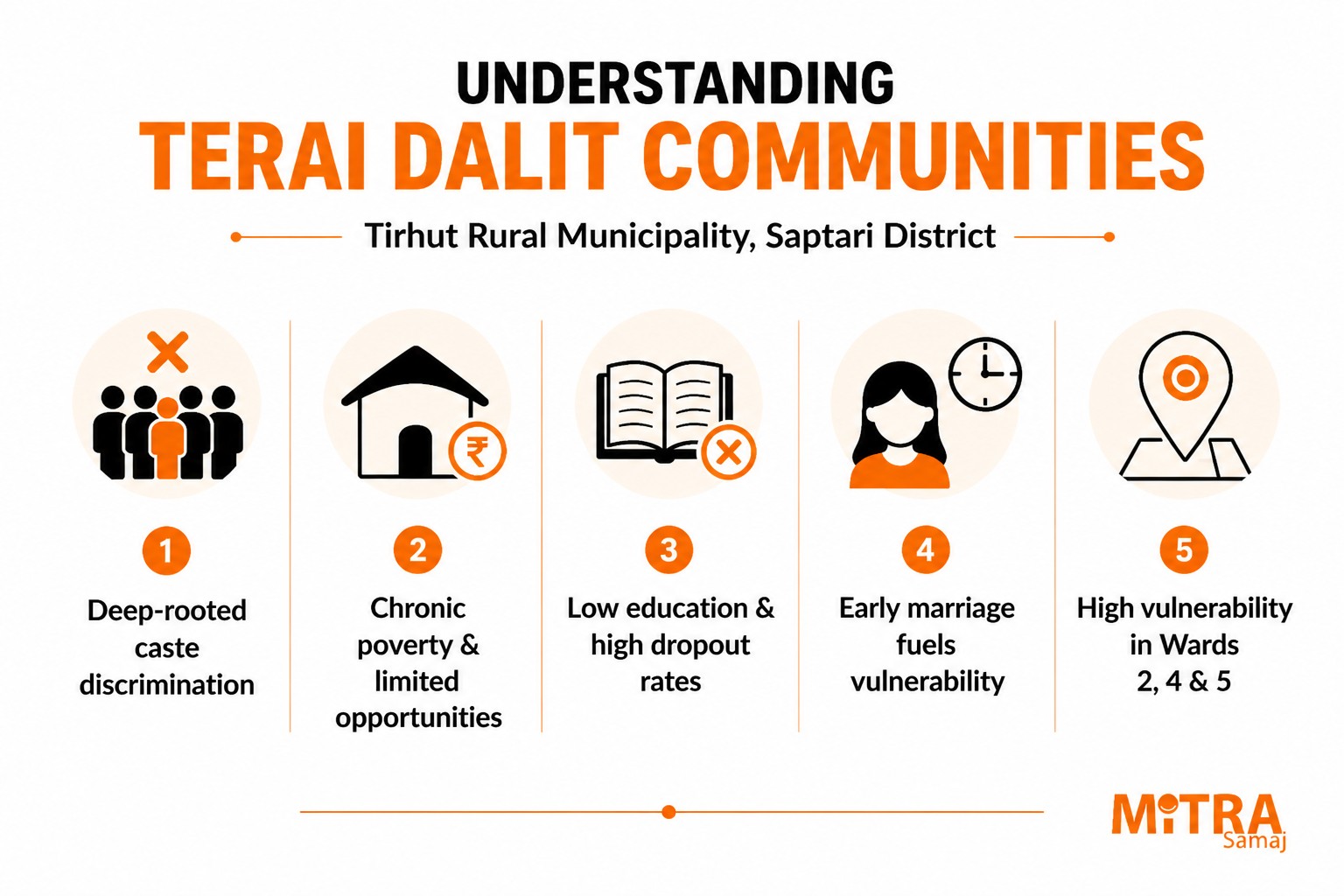
MITRA Samaj is excited to announce the launch of a comprehensive baseline study aimed at understanding the socio-economic, educational, and cultural realities of the Madhesi Dalit communities in Tirhut Rural Municipality, Saptari District. This study has just commenced, and our team is actively implementing it across Wards 2, 4, and 5.
Madhesi Dalit communities have historically faced social exclusion, caste-based discrimination, and economic marginalization, particularly in the Terai region of Nepal. These long-standing inequities have limited access to education, livelihoods, healthcare, and basic rights, contributing to persistent cycles of poverty and social vulnerability. Practices such as early marriage among girls further exacerbate these challenges, leading to health risks, school discontinuation, and economic dependency.
Recognizing the urgent need for evidence-based interventions, MITRA Samaj has designed this baseline study to establish benchmark data on the current status of Dalit households and adolescents in the targeted wards. The study aims to inform future community development programs, ensuring that initiatives are responsive, targeted, and effective.
The study will focus on:
- Understanding demographic and social characteristics, including age, sex, caste composition, marital status, and early marriage patterns.
- Assessing education and literacy levels, enrollment, educational attainment, scholarship access, and barriers to learning.
- Examining livelihood conditions, income sources, land and livestock ownership, food security, housing, and access to basic services.
- Evaluating access to civil documentation, government services, and participation in community and governance processes.
- Assessing the situation and empowerment of adolescents and young women (12–22 years), including education, income generation, decision-making autonomy, and participation in development initiatives.
MITRA Samaj is implementing a quantitative cross-sectional survey, complemented with qualitative methods. A census approach will be used for household surveys, ensuring that every household in the selected wards is included. All seven schools within Wards 2, 4, and 5 will undergo a full assessment. Additionally, the study incorporates focus group discussions, key informant interviews, and case stories to capture deeper insights from the community.
By combining structured household surveys with qualitative perspectives, MITRA Samaj aims to produce reliable, comprehensive, and actionable data that will serve as a foundation for improving socio-economic and educational conditions in Tirhut Rural Municipality.
As we roll out this study, MITRA Samaj remains committed to engaging with communities respectfully and ethically, ensuring that the voices and experiences of Madhesi Dalit communities guide future interventions.
This launch marks a significant step forward in building evidence-driven solutions for social inclusion, empowerment, and sustainable development in Nepal’s Terai region
“Madhesi Dalit communities have historically faced social exclusion, caste-based discrimination, and economic marginalization.”